16th LISA Symposium, poster
PDot Measurement for Detached White Dwarf Binaries as Future LISA Sources
Mar 2026 – present, supervised by Dr. Warren Brown, Smithsonian Institution and CfA at Harvard University
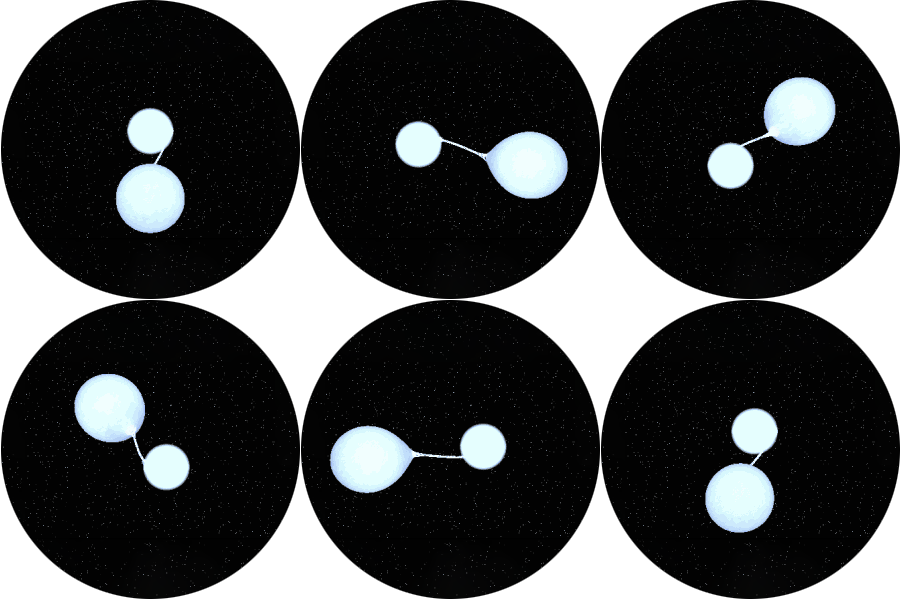
Galactic double white dwarf binaries are a prolific LISA source class, though most detached binaries appear as mono-frequency sources. This work presents optical time-series spectroscopy for known LISA white dwarf binaries, fitting the radial-velocity phase across epochs to demonstrate that orbital-frequency-change measurements are possible for non-eclipsing systems, enabling physical understanding of these future multi-messenger laboratories.
Journal of Electric Propulsion, under review
Machine Learning Techniques for Performance Prediction in Low-Power Hall Effect Thrusters Operating on Monoatomic and Molecular Propellants
Nov 2025 – Jul 2026, supervised by Dr. Dan Lev, HPEPL, Georgia Institute of Technology
The shift toward low-power Hall effect thrusters and alternative molecular propellants requires predictive models that go beyond traditional monatomic empirical scaling laws. This work develops a propellant-agnostic machine learning framework to predict thrust, beam current, and discharge current across varied propellants (Xe, Kr, Ar, CO₂, N₂) in low-power regimes.